Audio Drama Explained: What is a Radio Play and How Does Sound Design Tell a Story?
In the vast and growing world of audio content, you’ve likely encountered the term “audio drama.” But what exactly is it, and how does this powerful format manage to tell a complex story without a single visual?
An audio drama, often referred to as a radio play or audio fiction podcast in its modern form, is a narrative told entirely through sound. Think of it as a movie or a stage play where the only sense engaged is your hearing. It is a powerful art form that uses dialogue, voice acting, music, and detailed sound design to transport you directly into the scene.
It’s “theatre for the mind,” demanding and rewarding the listener’s imagination in a way few other media can.
The History of Audio Fiction: From Golden Age Radio to Modern Podcasts
The current popularity of audio drama is actually a revival of a much older medium. Understanding its history is key to appreciating its modern form.
The Golden Age of Radio (1920s – 1950s)
Before television became a fixture, the radio was the king of family entertainment, birthing the golden age of the radio play.
- Mass Appeal: Families would gather around the radio set every evening to listen to serialized dramas, comedies, and mystery shows.
- Iconic Shows: Productions like The Shadow and War of the Worlds demonstrated the immense power of sound to create immediate, visceral reality.
- Decline: The rise of television in the 1950s led to the decline of the traditional radio drama in the US, though it continued strongly in the UK (BBC Radio) and elsewhere.
The Modern Renaissance: The Rise of Audio Fiction Podcasts
The early 2000s saw the birth of podcasting, providing an independent, low-cost distribution platform for podcast fiction.
- The Catalyst: The success of narrative podcasts like Serial in 2014 showed a massive audience hunger for immersive, episodic storytelling.
- The Shift: Creators revived the techniques of the old radio plays. Today, the audio drama podcast is a thriving, high-budget cinematic medium attracting A-list talent and available on every major streaming platform.
Audio Drama vs. Cinematic Audiobook: Key Differences
The line between an audio drama and other high-production audio content, like a “cinematic audiobook,” can seem blurry, but the key distinction lies in the source material and the narrative structure.
1. Cinematic Audiobooks Explained
- Source Material: An oral performance of an existing book or novel.
- Narrative Core: The story is fundamentally driven by a narrator who reads the author’s prose, including descriptions of settings, actions, and character thoughts (e.g., “She sighed and walked out the door”).
- Enhancements: While they layer in a full cast for character dialogue, along with music and basic sound effects, the primary storytelling mechanism remains the text read by the central narrator.
2. Audio Drama (The True Radio Play)
- Source Material: Created from an original script written specifically for the audio-only medium.
- Narrative Core: The story is told almost exclusively through dialogue and sound effects. There is typically no omniscient narrator describing the action.
- Sound Design over Narration: Instead of a narrator saying, “He nervously took a sip of his lukewarm coffee,” you only hear the subtle clink of the mug, the slurp, and the actor’s tense breathing to convey the feeling.
| Feature | Audio Drama | Cinematic Audiobook |
| Source Text | Original script written for audio | Existing book/novel |
| Narrative Engine | Dialogue, Sound Effects, and Music | Omniscient Narrator reading prose |
| Cast | Full cast of actors for all roles | Full cast for dialogue, but a single narrator is central |
| Format | “Movie for your ears” | “Enhanced reading of a book” |
The Production Pipeline: How Immersive Sound Design is Made
Producing an immersive audio drama is an intensive, multi-stage process that focuses on using sound to build a realistic world.
1. Scripting and Writing for the Ear
The script must work exclusively for the ear. The writer must constantly ask: How do I convey this action without visuals?
- Dialogue is Essential: Characters must naturally reveal their location, the time of day, and what they are seeing and doing through their conversation.
- Detailed Sound Notes: The script includes sound design directions that replace visual stage directions, prompting the sound designer to insert specific effects.
2. Casting, Voice Acting, and Direction
Finding the right voices and ensuring authentic delivery is paramount.
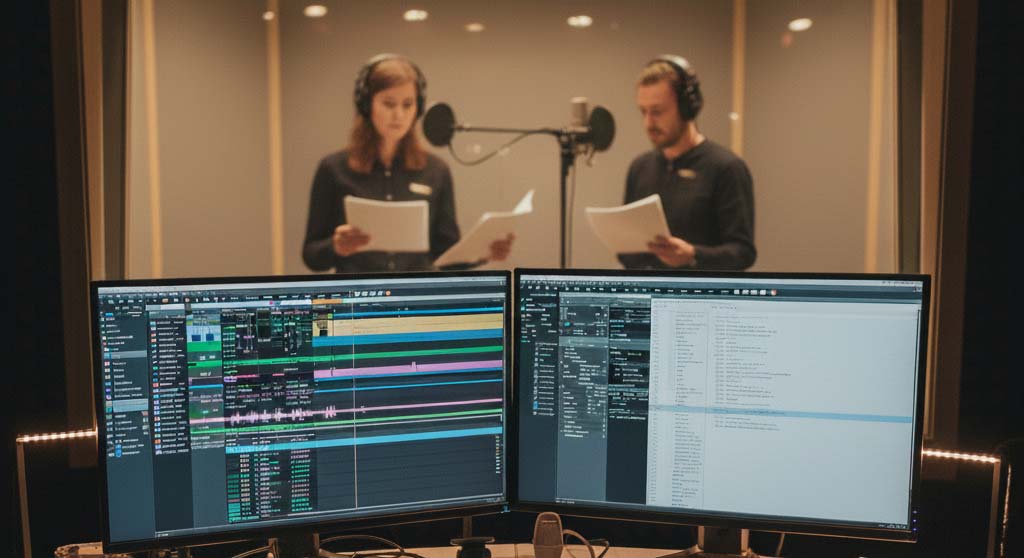
- Voice Acting: Actors are cast to create distinct vocal profiles. They record lines in a controlled environment to ensure the focus is purely on vocal performance.
- Direction: The director ensures the verbal descriptions and sonic cues are clear enough to paint the required mental picture for the listener.
3. Post-Production, Foley, and Mixing
This is where the magic happens, transforming raw dialogue into a living world using high-quality sound design.
- Foley and Soundscaping: The Sound Designer adds all the background noise and specific effects. This includes:
- Ambient Beds: The continuous background sound (e.g., the distant traffic of a city street, or the hum of a spaceship).
- Spot Effects: Specific, one-time sounds that represent action (e.g., a door creaking, a punch).
- Binaural Sound and Panning: The dialogue, sound effects, and musical score are carefully blended. Panning (moving sound between the left and right headphones) is used extensively to place characters and objects in a 3D space, making the listener feel like they are truly in the scene.
Quick Answers: FAQ for Audio Drama and Radio Plays
What is the core difference between an audio drama and an audiobook?
An audio drama is based on an original script and is told primarily through dialogue, sound effects, and music, without a narrator describing the action. An audiobook is a reading of an existing novel by a narrator, even if it is enhanced with music and a full cast (a cinematic audiobook).
Is an audio drama the same as a radio play?
Yes. “Radio play” is the traditional term from the medium’s Golden Age. “Audio drama” or “audio fiction podcast” are the modern terms, but they refer to the same narrative format.
What genres are best suited for audio drama?
Horror, Sci-Fi, Thrillers, and Mystery are highly suited for audio drama. The sound-only format allows creators to build vast, imaginative worlds cheaply and effectively exploit the listener’s natural fear of the unseen.
How does audio drama tell a story without visuals?
It uses detailed sound design (Foley, ambiance, spot effects) to create the environment, and dialogue to have characters reveal their location, actions, and feelings, prompting the listener’s imagination to fill in the visual gaps.