The Importance of Having a 5.1 Mix for Film Festivals and Home Entertainment Releases
This article will discuss the importance of having your independent film mixed in 5.1 surround sound for screening at film festivals and OTT streaming platforms, as well as provide tips on how to achieve this in a cost-effective and efficient manner.
Do film festivals require a 5.1 mix to screen your film?
Film festivals showcase the best and most innovative works in the world of cinema. As a filmmaker, you may find yourself wondering if having a 5.1 mix is even necessary to have your film screened at these prestigious events.
While there is no one-size-fits-all answer to this question, it is essential to understand the significance of audio quality in enhancing the overall cinematic experience. In this introduction, we will explore why delivering a 5.1 mix for film festivals can be a valuable asset for your film's success on the big screen.
Film festivals and the audio requirements
While many independent festivals accept stereo (2.0) tracks, delivering a true 5.1 surround mix ensures your project takes full advantage of cinema playback systems. Presenting a multichannel mix allows for an immersive and captivating viewing experience, enhancing the overall impact of your work on the audience. By meeting this professional standard, you demonstrate a commitment to delivering an exceptional cinematic presentation.
If a film festival screens films in a large-format venue or commercial theater, delivering a surround sound master is strongly recommended to fill the acoustic space properly. In these settings, a DCP (Digital Cinema Package)—which natively supports uncompressed 5.1 linear PCM audio—will often be required.

For submitting your film to OTT streaming platforms, network delivery guidelines strictly require both a 5.1 print master and a 2.0 stereo mix. Not anticipating these audio formats early can trigger Quality Control (QC) rejections and delay your film's distribution release.
The Benefits of a Surround Sound Mix for Film Screenings
In the world of film screenings, sound reproduction is just as crucial as the visual presentation. Surround sound technology has transformed how audiences experience cinema, providing a level of spatial engagement that standard stereo cannot match.
By establishing a full multi-channel soundfield, a surround mix brings films to life, placing the viewer in the center of the narrative environment.
What is 5.1 Surround Sound?
A primary benefit of a 5.1 surround sound mix is its ability to direct discrete audio to specific speaker positions—Left, Center, Right, Left Surround, Right Surround, and Subwoofer (LFE). By placing sounds strategically around the theater, viewers feel integrated into the environment on screen.
Whether localized sound effects move across the theater or low-frequency transients resonate through the auditorium, surround technology delivers a realistic audio environment.
Furthermore, a 5.1 mix adds depth and clarity to complex audio track stacks. It allows precise spatial placement across the frequency spectrum, making it easier for mixers to create balance, maintain dialogue intelligibility, and direct the audience's focus. Every subtle acoustic detail and dynamic shift can be accurately represented, elevating emotional impact and narrative clarity.
Another advantage is native compatibility with modern cinema processor chains and multi-channel home audio systems. Deliverables formatted in 5.1 guarantee that your audience experiences the balance, dynamics, and spatial intention crafted during the re-recording process.
How do you get your stereo-mixed film converted to 5.1 surround sound?
Encountering a technical QC failure or distributor rejection because a film lacks a surround print master can delay release schedules and create unexpected remastering costs. Securing a compliant multi-channel master alongside your stereo track ensures a seamless delivery pipeline across all theatrical, festival, and VOD channels.
What are the options?
If you want to take your stereo-mixed film to the next level with 5.1 surround sound, there are a few options. First, you can work with a professional re-recording engineer or post studio specializing in surround mixing. They utilize specialized spatialization, stem positioning, and surround encoding tools to rebuild your audio assets into an immersive 5.1 master.
For tight turnarounds and budget-conscious productions, using a 5.1 upmixing service provides a practical, efficient route to achieve a compliant surround sound track without starting a full re-mix from scratch.
What is a 5.1 upmix?
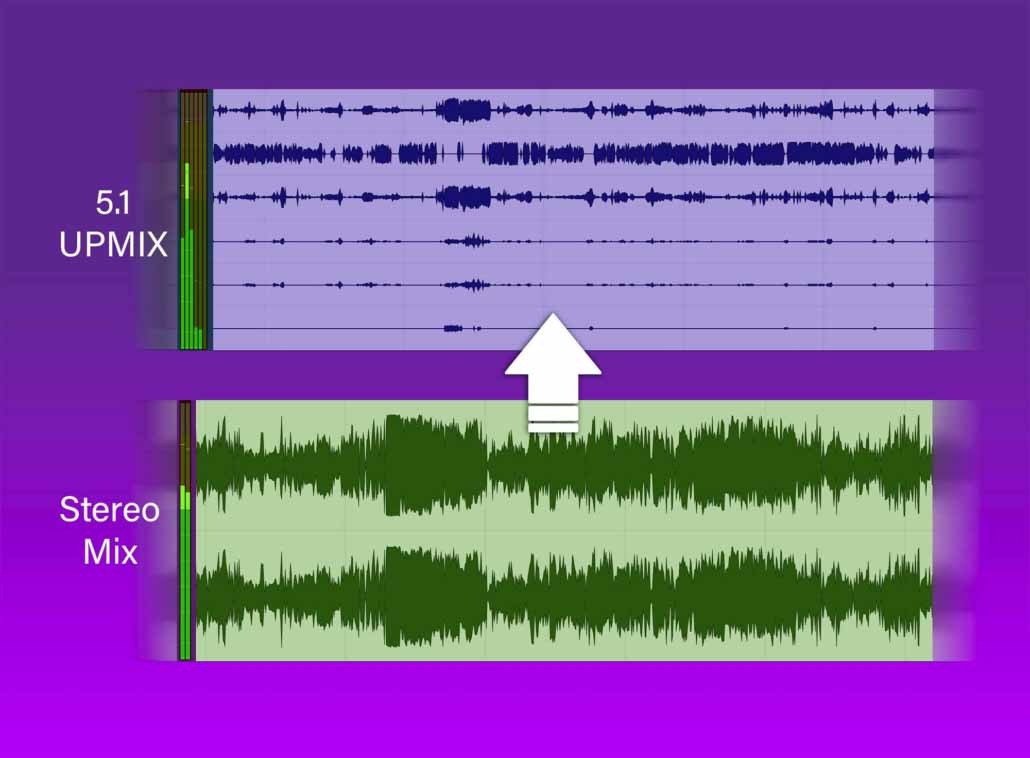 Upmixing is the process of taking stereo audio stems and processing them into a full multichannel configuration using dedicated DSP techniques. This approach expands 2-channel stems into discrete 5.1 channels for theatrical and broadcast applications. Key stems required for this process include separate stereo passes for Dialogue, SFX, Foley, Ambience, and Music.
By providing clean stereo stems of the final film audio, an experienced engineer can transform those elements into an expansive 5.1 surround mix. This workflow produces consistent results that pass rigorous technical Quality Control (QC) standards for broadcast and streaming distribution.
Discover the benefits of our 5.1 upmixing services for your film on our dedicated service page.
Conclusion
A 5.1 surround sound mix delivers significant value for film screenings by providing an immersive audio environment that reinforces the visual narrative. Whether screening in an auditorium or delivering to streaming platforms, incorporating multi-channel delivery ensures your film reaches its full cinematic potential.