Navigating the Complicities of M&E for Film Distribution
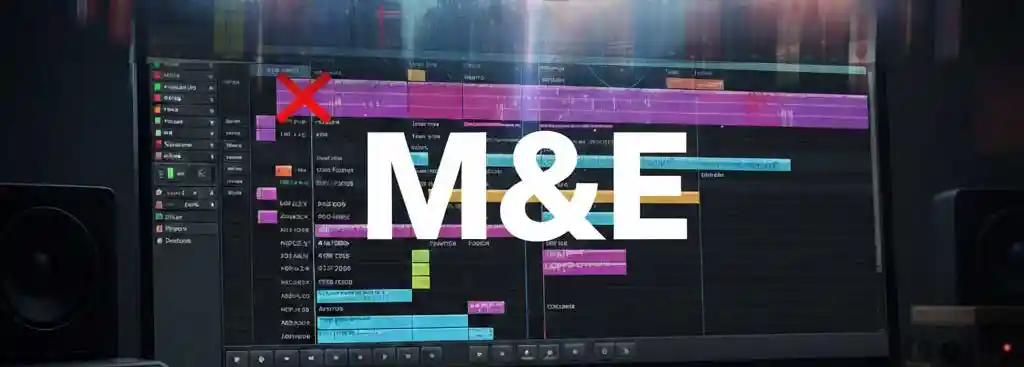
You’ve finally locked the picture, finished the color grade, and a distributor is actually interested. Then you look at the delivery checklist and see a requirement for a “Fully Filled M&E.”
What Exactly is a “Fully Filled” M&E?
In the world of international delivery, “Fully Filled” means that the Music and Effects tracks must contain every single non-dialogue sound present in the original mix. When the English dialogue is removed, there cannot be any holes or “dead air.” If a character in the original version sets a glass on a table while speaking, that “clink” must exist on the M&E track even though the voice is gone.
A standard M&E might just be a dip of the music and whatever effects were already in the timeline. A Fully Filled M&E, however, requires a total reconstruction of the sonic environment. This includes:
- Full Foley Coverage: Every footstep, cloth movement, and prop handled by actors.
- Comprehensive Ambience: Continuous background textures like wind, traffic, or room tone that stay consistent throughout a scene.
- Incidental Sound Effects: Door slams, car engines, and weather elements that were originally captured by the dialogue microphone.
Essentially, a foreign language dubbing studio should be able to drop their new dialogue on top of your Fully Filled M&E and have the movie sound exactly as you intended, just in a different language.
For many indie filmmakers, this is the moment the celebration stops. If you didn’t plan for a Music and Effects track during production and early post, you’re looking at a major technical hurdle that can be both expensive and time-consuming to clear.
1. The Distributor’s “Hard Pass”
A distributor needs an M&E track because they plan to sell your film to international territories. To do that, a foreign studio has to dub the dialogue into another language. If you don’t provide a high-quality audio track that contains every single sound, such as backgrounds, footsteps, car engines, and the score, they simply can’t sell it. No M&E usually means no deal for major distribution.
2. The “Muted Production” Trap
This is where most indie projects hit a wall. On a typical low-budget set, the “sound” of the movie is often just whatever the boom mic or lavalier caught while the actors were talking. That microphone didn’t just grab the dialogue; it grabbed the sound of their shoes on the floor, a chair scraping, or a door slamming.
The second, a sound engineer mutes that dialogue track to create the M&E; all of those physical sounds disappear. You’re left with digital silence, a void where there should be life. If you didn’t record dedicated Foley or heavy sound design during the edit, your film will sound like a hollow shell the moment the voices are gone.
3. The Reality of the “Build”
Many filmmakers think creating an M&E is just a matter of muting the vocal stems. In reality, it’s a ground-up reconstruction. An engineer has to go through the entire film and:
- Harvest PFX: Scour the raw production audio to find “clean” sound effects that happened between lines of dialogue.
- Perform Foley: Every footstep, hand touch, and clothing rustle needs to be re-recorded in a studio to replace what was lost.
- Layer Ambiance: You have to rebuild the “air” of every room so there’s never a total drop-out of sound.
- Handle Non-Verbals: Decisions have to be made on screams, breaths, and laughs—do they stay or do they go?
4. The Lyric Conflict
Music is another common trap. If your film features songs with lyrics, those vocals are technically “dialogue.” In many international markets, those lyrics need to be removed or translated.
If you didn’t secure the instrumental stems from your composer or music supervisor during the initial deal, you’re stuck. Trying to “strip” vocals out of a finished song after the fact usually results in a muddy, unusable mess that won’t pass quality control. Just like the main dialogue, these vocals often need to be removed and overdubbed for foreign markets.
5. The Budget Buster: The Hidden Cost of Foley
One of the most jarring realizations for an indie filmmaker comes during this final delivery phase. You’ve already spent your budget on the shoot, the edit, and the color grade. Now, you realize your film is missing 70% of its physical sound because it was all buried under the dialogue.
To fix this, you need Foley. For a full-length feature, professional Foley can easily run into the thousands of dollars. It requires a specialized studio, a prop warehouse, and artists who perform these sounds in sync with your picture.
If you didn’t account for this during production, it can quickly become an impossible expense because the film budget has already been used up. Many filmmakers find themselves in a catch-22: they need the distribution deal to get paid, but they can’t afford the M&E required to sign the deal.
Don’t Let Your Distribution Deal Stall
Creating a “Fully Filled” M&E is a meticulous process that requires a high level of technical precision and an ear for detail. It isn’t just a button you press at the end of a mix.
If you’re facing a distribution deadline and realize your audio isn’t up to spec, TravSonic can help. We specialize in building professional M&E tracks that meet strict delivery requirements, ensuring your film is actually ready for the world stage.