Automated Dialogue Replacement (ADR) and How It’s Used

What is Automated Dialogue Replacement?
Automated Dialogue Replacement, or ADR for short, is the process of replacing the original dialogue in a video or film with new dialogue to match. This technique can be used for many reasons, such as fixing poorly recorded audio, replacing an actor’s voice with a more famous star’s voice, or changing the language of the dialogue.
 The ADR technique has been around since the 1920s, but it has become more popular in recent years due to the rise of technology. The process is used to replace lines that are poorly recorded onsite during film production. The originally recorded lines might be too quiet to be heard on camera, have extensive background noise, or have other common sound-related recording issues.
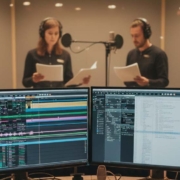
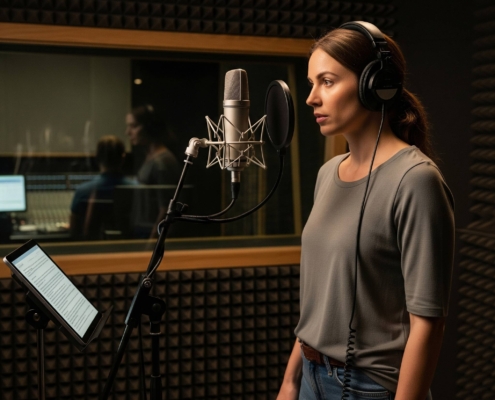
ADR is done during the post-production stage of a film by recording new dialogue over the original audio track. The process of ADR is usually recorded in a recording studio with an actor or actress watching the completed footage on a monitor while they speak their lines to match lip movements. This is called a “looping” session.
Why would dialogue need to be re-recorded?
Dialogue is a crucial aspect of any film. It conveys the story and tells the audience what they should be paying attention to make sense of the narrative. Dialogue needs to sound natural and convincing, but sometimes the sound quality may be poor, or the actor’s voice may not match their character, or for any number of reasons.
The production sound mixer is responsible for recording dialogue during filming. They set up microphones in the right place and record the sound, whether it is dialogue or ambient noise. Then they mix all the different sounds to achieve a cohesive audio track that can match the filmmaker’s vision. In some cases, the sound environment can not be controlled and is not suitable for the final production.
There are many techniques to remedy poor sound quality, such as noise reduction, re-recording, mixing sound effects with dialogue, and more. In short, it’s best to use a variety of techniques to make the dialogue as clear as possible for the audience.
While the concept of ADR may seem straightforward, its execution requires an incredible amount of focus and intensity from an actor. To truly appreciate the craft, take a look at this high-octane example of Hugh Jackman as he re-records his vocals for a high-stakes scene in Logan at Hyperbolic Audio in New York City. This clip demonstrates how ADR is used to layer in complex vocalizations that the original on-set microphones might not have captured with the necessary clarity.
![Hugh Jackman Doing ADR For Logan [Must See]](https://i.ytimg.com/vi/DyS5agWSIrY/0.jpg "Automated Dialogue Replacement (ADR) and How It’s Used")
What is a voice looping session?
A voice “looping” refers to the actor watching a short segment of film on a continuous loop until they nail the synchronization with their on-screen performance. This helps with punctuation, word spacing, and emphasis. This also gives the audio engineer many takes to choose from to make a final ADR comp for the film.
What is the difference between ADR and a VoiceOver Session?
It’s a common misconception that ADR and VoiceOver (VO) are one and the same, but the technical demands of each can vary significantly.
To help distinguish between the two, here are the primary differences:
- The Goal: ADR is corrective. It’s about replacing or “fixing” existing dialogue to match a visual performance already captured on camera. Voiceover is additive, providing new information, narration, or the original voice for an animated character.
- Visual Constraints: In ADR, the actor is “locked” to the screen; every breath and syllable must perfectly align with the lip movements of the footage. Voiceover offers more creative freedom with timing, as the visuals are often edited later to match the vocal performance.
- Acoustic Matching: A major part of the ADR process is making the studio recording sound like it happened on location (using techniques like convolution reverb). Voiceover usually prioritizes “radio-ready” clarity and intimacy, sounding like a direct communication to the audience.
- Technical Setup: ADR sessions often use microphones similar to those used on set (like shotgun or lavalier mics) to maintain tonal consistency. VO sessions typically utilize large-diaphragm condenser microphones to capture a rich, full-range vocal tone.
In this behind-the-scenes look at the making of Frozen at Disney Animation Studios, Jonathan Groff (the voice of Kristoff) illustrates the nuance of character-driven performance in a controlled environment. Use this video as a reference to understand how vocal delivery is fine-tuned to breathe life into an animated scene, a process that is often distinct from the real-time replacement of dialogue in live-action film.

From the Booth to the Big Screen: A Frozen II Case Study
While the theory of ADR and VoiceOver is straightforward, the technical execution often involves complex, global collaboration. A standout example of this in a finished product is the opening scene of Frozen II featuring Young Elsa.
To capture these lines, the performance by Mattea Conforti was tracked in-house at TravSonic Studios by Chief Audio Engineer Aaron R Reppert. Although the actress was in our booth, we were linked directly to Disney Animation Studios in Los Angeles, more than a thousand miles away. By utilizing Source Connect, we streamed high-definition audio in real-time, allowing the Disney directors to monitor and direct the performance as if they were sitting in the same room.
Once the session wrapped, the raw recordings were delivered to Disney’s post-production team for the final edit and mix. The result is a seamless performance that matches the character’s nuances and the film’s atmosphere perfectly, a prime example of how remote technology and precise engineering come together in modern cinema.

How is the original and newly recorded dialogue edited to match?
The newly recorded dialogue is edited and processed to match the tone and synchronization of the film footage. For example, unwanted sounds or background noise can be removed, a voice can be made to appear closer or farther away, and the tempo and tone can be sped up or slowed down.
One technique that is used to align ADR to the original dialogue recording is to use an audio plugin such as VocAlign. This procedure is used to align ADR to the original dialogue recording to match the actor’s lips and mouth movements onscreen. It offers a lot of flexibility. VocAlign allows you to shift the timing of each voice so that they are in sync with one another.

How is the tone of ADR processed to match the original recording?
At times, only a section or specific actor needs to have the dialogue re-recorded using ADR. This will have the studio recording sound different than the other on-location lines. For example, the original dialogue recording might have a room echo that needs to be emulated in post-production. This is when convolution reverb comes into play.
Using Convolution Reverbs in Post
Convolution reverb is the process of modifying a sound with an impulse response from another sound source. Convolution reverbs produce a wide variety of sounds and can be used to create everything from dark ambiance in horror films to the echo of a cathedral, or a simple as a small room. This makes it possible to process the newly recorded ADR to match the tone of the room or environment in a film.

Altiverb is a plug-in with more than 500 room, hall, church, arena, etc., presets to give your music depth and space.
The Final Word on ADR
Ultimately, the goal of ADR is invisibility. Whether we are matching the high-intensity performance of an action star or capturing the delicate nuances of an animated character, the success of the session lies in the details. By combining traditional performance techniques with modern tools like Source Connect and VocAlign, we bridge the gap between a raw on-set recording and a polished, cinematic experience.
Great audio is often the element an audience doesn’t notice, and in the world of ADR, that is the highest compliment a production can receive.