PDF Manuscript to Audiobook & Adaptation: The Complete Preparation Guide
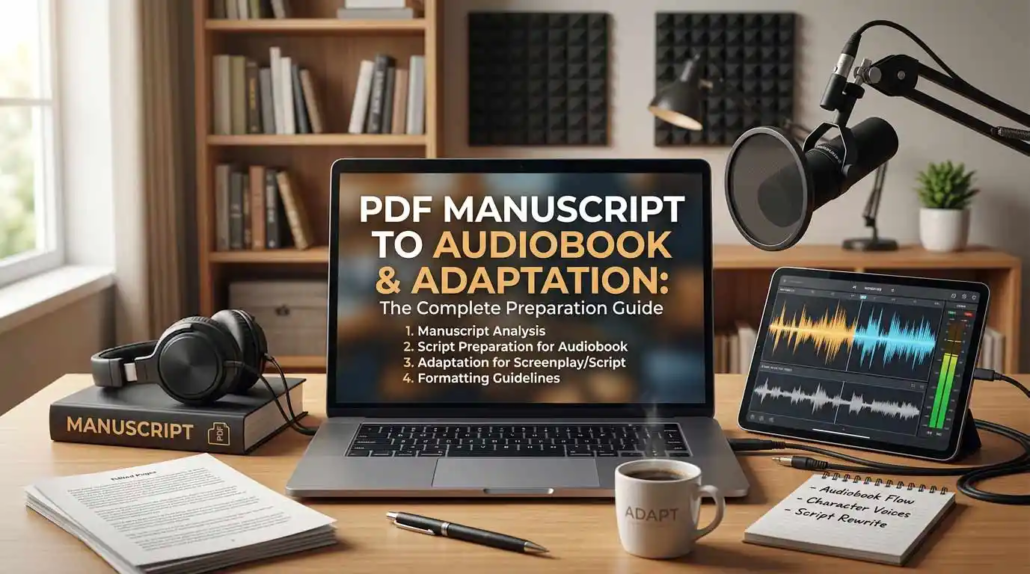
From Page to Ear: The Art of Professional Audiobook Production
Turning a finished book into a professional audiobook is often perceived as a simple one-to-one translation, essentially reading the text aloud or feeding a file into an AI voice generator. However, creating a high-fidelity listening experience requires a specialized metamorphosis. The transition from a visual medium to an auditory one involves a meticulous audiobook production process of adaptation, technical refinement, and quality control.
Reformatting and structuring a manuscript for an audio environment is a dense, granular task. Without specific industry experience and the right specialized audiobook software tools, this phase can become incredibly time-consuming. If a manuscript is not professionally formatted from the outset, the end result can lead to thousands of individual edits and AI voice regenerations. This creates a massive logistical burden and adds high, unnecessary costs to the audiobook production budget.
1. The Linguistic Audiobook Adaptation (Script Preparation)
A manuscript written for the eye does not always translate well for the ear. Before a single word is recorded or generated via TTS, the text must undergo a specialized audiobook sanitization and adaptation.
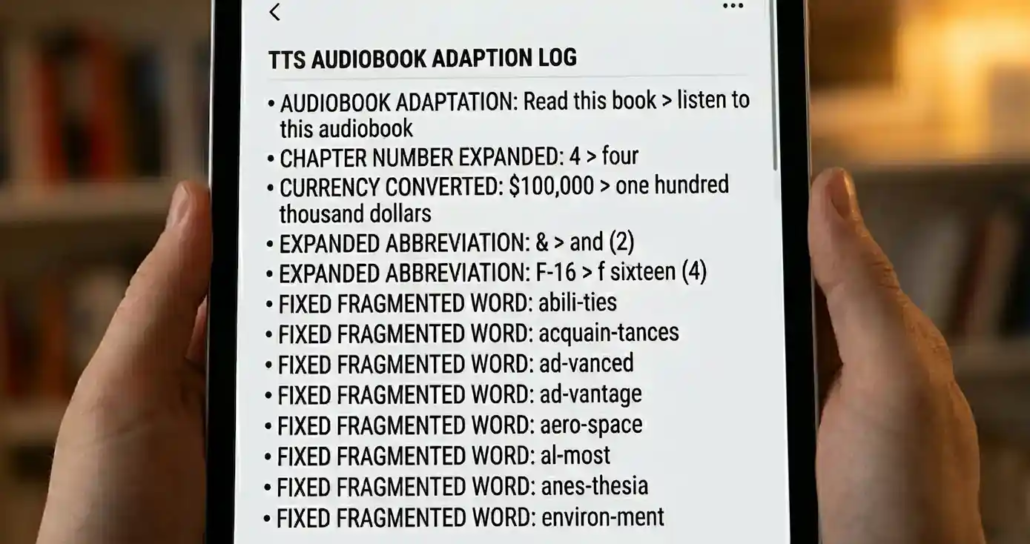 Readers navigate books differently from how listeners consume digital audiobooks. Phrases like "as you see in the chart below" become jarring distractions in an audio format. These must be adjusted to "as you hear" or "as discussed previously." Furthermore, visual cues such as footnotes and sidebars must be integrated into the audiobook narration flow or omitted to maintain listener immersion. This is especially important for a dramatized audiobook adaptation.

2. The PDF Transcript Trap
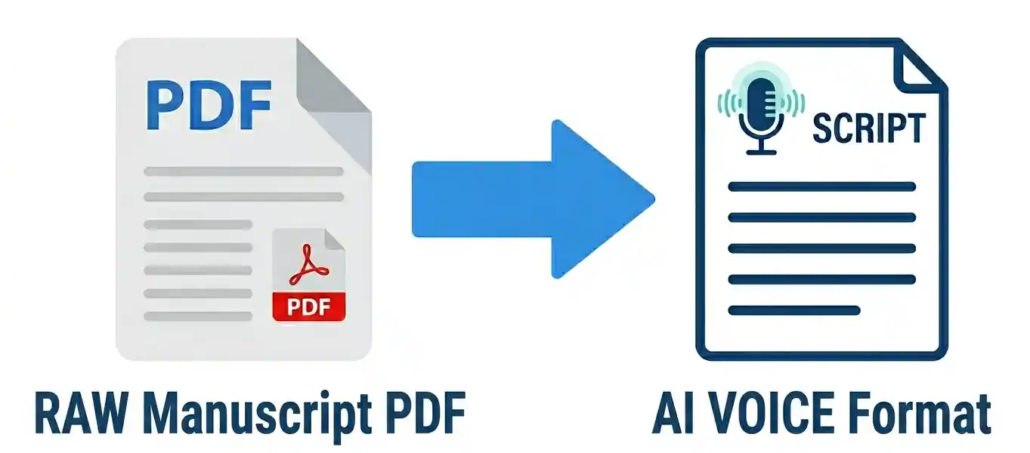
A lot of people will try to take their final PDF and copy-paste the text into a program to make an audiobook. You will run into problems right away when trying to use text-to-speech programs with this. Your PDF will most likely give you problems.
Your PDF will have some type of coding on it that can cause your text to become symbols once put into your TTS. This will make it impossible to create an AI audiobook. We will convert your PDF into a proper file for you to use. While keeping the text as you have written.
3. The Human Element: Author-Read & Narrated Works
Many authors like to provide their own voice for their books. This can create some technical difficulties when trying to get your audiobook recorded.
- The Recording Environment: It can be hard to get your room to be "dead". Unless you're in an audiobook recording studio
- Room Tone: Your editor will need a good clip of room tone to fill in gaps when editing your audio.
- Technical Setup: If you want to record your voice professionally, you will need to know what mics and interfaces to use. Otherwise, you'll have thin-sounding audio.
- Performance Fatigue: Narrating a book for many hours will take time to learn how to do properly.
- Quality Factor: If your quality fluctuates between sessions, it will take more time to edit your audio.
4. The Digital Bridge: Directing the AI Performance
As we know, with Ai voice's they are very fast. When you're dealing with a raw manuscript, there are many things you need to fix in order to produce quality AI voice work. Here are some things that should be removed from your file:
- End-of-Line Hyphens: You want the AI voice to flow throughout the file. Any hyphens at the end of lines should be joined back together.
- The Translation of Logic: The AI voice needs to understand what you're saying. Change any numbers or abbreviations into words to produce quality text-to-speech.
- Specialized Vocabulary: There are certain words that an AI voice may not know how to pronounce. This could be medical terms or other difficult-to-spell words. We can create a dictionary of these words to make sure your AI voice knows how to pronounce them.
- Platform Tagging (SSML): Professional TTS platforms require SSML tagging to control pauses, inflection, and character changes. Without this precise tagging, the AI audio can sound monotonous or robotic.
- Symbol & Formatting Noise: Page numbers and headers must be purged so they aren't read aloud by the AI narrator.
- The Hidden Costs of AI: Many AI voice platforms use credits to generate your AI voice. By formatting and tagging your file correctly, you will save yourself money on poor takes and regenerating your AI voice.
5. The Critical Step: Audiobook Proofing
You need to have your audiobook proofed no matter how you decide to narrate it. Having an error caught after you've published your audiobook will be very discouraging. When proofing, you need to go through each word of your book to make sure your audiobook flows correctly.
6. The Final Hand-off: Retail Readiness & Assets
Once the audiobook recording is finished, the work moves into the "Retail Ready" phase for audiobook distribution.
- Credits & Metadata: Audiobook openings and closings must follow specific industry formats for platforms like Audible.
- Retail Samples: Selecting a curated audiobook sample is a strategic choice to hook potential buyers.
- Audio Branding: Adding professional intro music elevates the audiobook production value.
7. Mastering Audiobooks to Industry Standards
The final step is technical audio mastering. Every major audiobook platform has strict specifications regarding loudness levels (RMS) and noise floors. Without professional audio mastering, your book might fail to meet the submission standards of Audible, Spotify, or Apple Books.
How TravSonic Simplifies the Journey
Converting a PDF to an audiobook can be very tedious. We at TravSonic fill the gap between your manuscript and your finished product.
Here are some examples of what we can help you with:
- Convert PDF to text: Help recover your manuscript for optimal AI voice conversion.
- Sanitize your manuscript and SSML tagging: Help prevent TTS pitfalls and improve your AI voice's inflection, which will save you money when generating.
- Recording your voice over as the author: Help guide you through any difficulties you may face when trying to get your voice recorded.
- Help with converting your book to be read as an audiobook: We can edit your words to better fit an audiobook experience.
- Prepare for Retail: Help with QC to ensure your audiobook is ready to publish.
- Proofing and Mastering: An added layer of help when it comes to converting your manuscript to an audiobook. We want to ensure that your book is publishable.
We have created in-house proprietary software programs that will help with the process of adapting large books. Some things our software can do are:
- Quickly outline large books: Our programs can read huge amounts of text to detect problems that may take an editor many days to go through and find.
- Fix mistakes: We can use our own code to detect errors and correct them quickly. Such as detecting when you "see" something instead of "hear".
- Adapt large books quicker: When dealing with many pages, we can fix errors faster than you would if you did it yourself.
Why These Tools Matter for Your Budget
There are many issues you will run into when converting a long document without using one of these audiobook software tools. This could cost you thousands of hours of editing and AI voice regenerations. By using our "Pre-Flight" service, we can help you find these landmines and fix them before you generate your files. Helping you save money on all those "bad takes".
Our Software allows you to convert with ease, but we still have Engineers making sure each conversion keeps your writing style. Helping you take your writing further than just text-to-speech.
Ready to hear your book come to life? Visit TravSonic Audiobook Services to learn more about our audiobook production and editing services.
Questions Answered in This Article
How do you format a PDF manuscript for AI text-to-speech audiobook engines without errors?
To prepare a PDF manuscript for text-to-speech (TTS) platforms, you must convert the document into a clean text format to purge embedded special characters, hidden formatting markers, and hyphenations. Raw PDF code frequently causes AI voice generators to stutter or misread the text as unreadable symbols. Professional audiobook production requires sanitizing these digital obstacles and spelling out acronyms, numbers, and symbols before initiating the voice generation process.
What is audiobook script sanitization and why is it necessary for production?
Script sanitization is the technical process of adapting text written for a visual medium so that it flows naturally in an auditory environment. This involves purging visual references like page numbers or headers and altering phrases like "as seen in the chart below" to spoken alternatives. Implementing this workflow alongside precise SSML tagging prevents monotonous pacing and protects your budget from expensive, redundant AI voice regenerations.
What technical standards must an audiobook meet for distribution on Audible or Spotify?
Major audio distribution platforms enforce strict technical specifications regarding Root Mean Square (RMS) loudness levels, peak limits, and background noise floors. Meeting these retail readiness standards requires expert audio mastering and rigorous quality control proofing to ensure the files are accepted on the first submission. Failing to optimize these technical elements will result in immediate rejection from retail platform pipelines.
How do specialized software tools lower audiobook production costs for large manuscripts?
Specialized automation utilities scan complex manuscripts to instantly locate and repair structural hurdles, end-of-line hyphens, and pronunciation traps before recording begins. Eliminating these errors through a pre-flight formatting service bypasses the need for thousands of manual audio edits or wasted credit generations on AI platforms. This hybrid approach pairs software-driven efficiency with human engineering oversight to accelerate production timelines while safeguarding the author's voice.