The AI Evolution: From Static Plugins to Intelligent Production | What’s next?
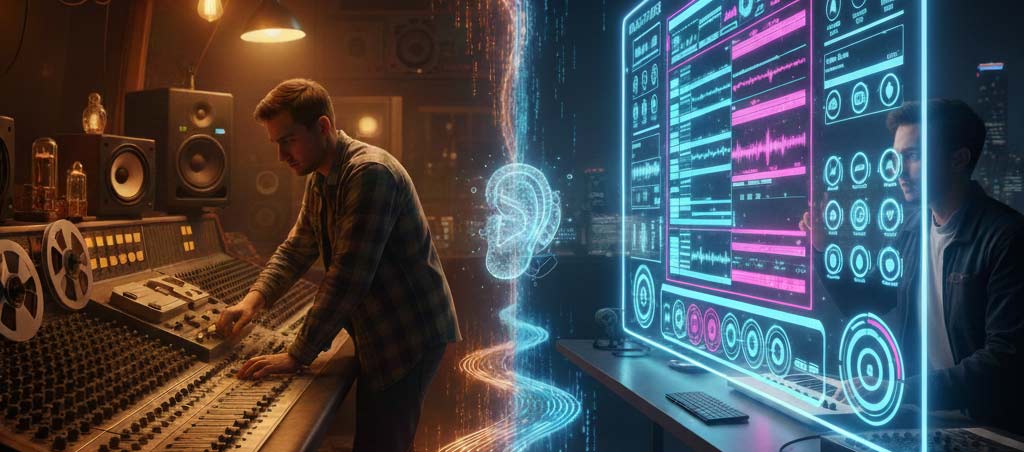
The Evolution of the Hybrid Audio Mix
As AI technology intensifies, the mixing landscape has shifted once again, but this isn’t the first time we’ve stood at a crossroads. Decades ago, the audio world was rocked by the first great debate: Analog vs. Digital. The late 90s served as the boiling point for this conflict, back when DAWs (digital audio workstations) finally became capable of handling full-scale professional productions.
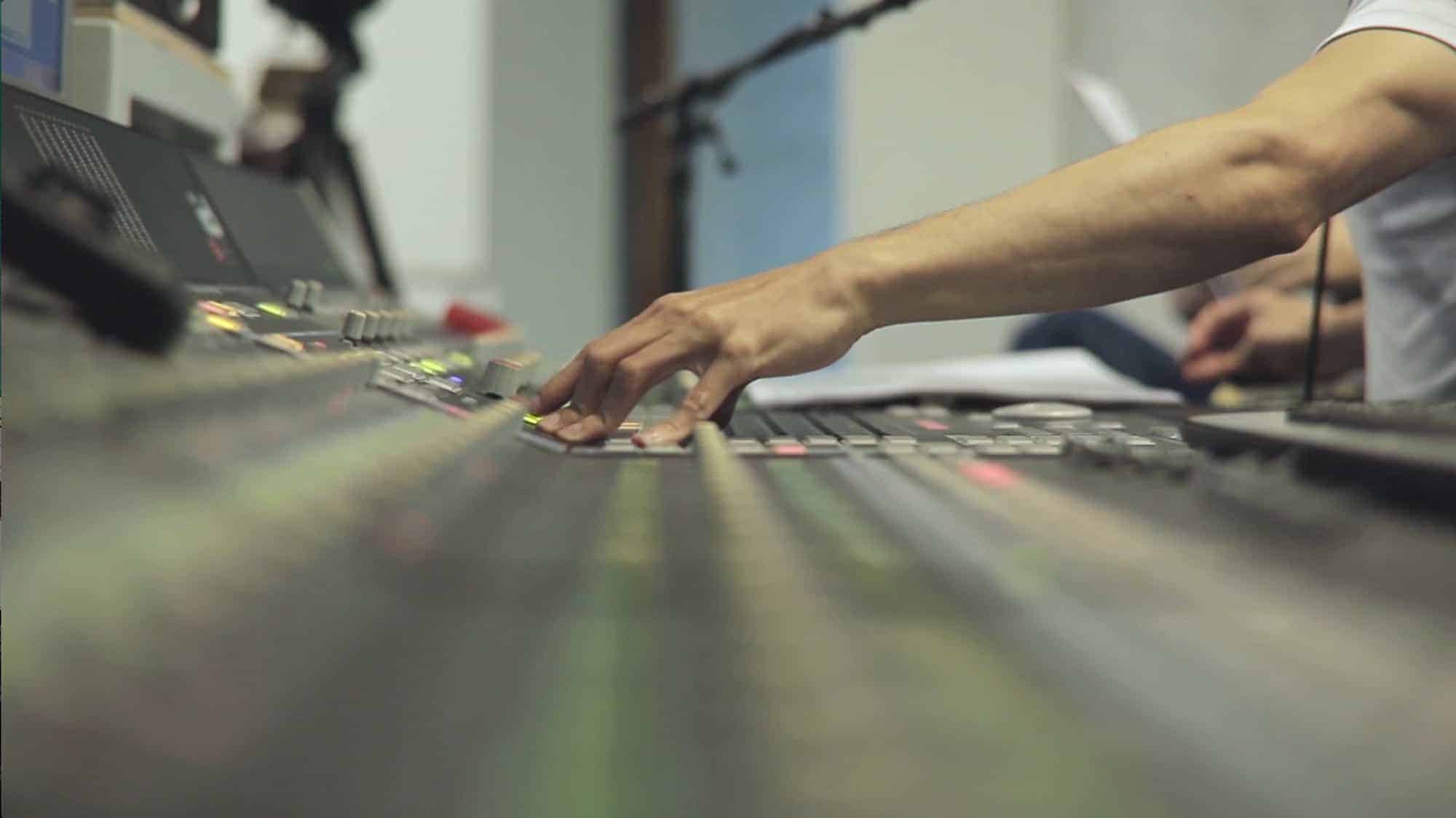
This hybrid audio mix concept first emerged in the late 1980s and early 1990s as engineers began to bridge the gap between classic analog warmth and the emerging precision of digital control. Iconic early examples like the SSL SL 9000 J/K Series with its groundbreaking TotalRecall automation and the Amek 9098i allowed engineers to store and recall complex analog settings digitally. By integrating digital brains into massive analog desks, these consoles paved the way for the software-dominant digital audio revolution we use today.
We eventually learned that the hybrid approach wasn’t just a compromise or fad. It was a shift to the norm where classic analog mixing consoles and studio outboard gear were integrated into the DAW. This created a sonic balance at a time when computers were not yet powerful enough to accurately emulate those analog classics. While the hardware provided the harmonic character and tactile control that defined a professional sound, the DAW offered a massive leap forward in editing precision and session recall.
The Portable Analog Revolution
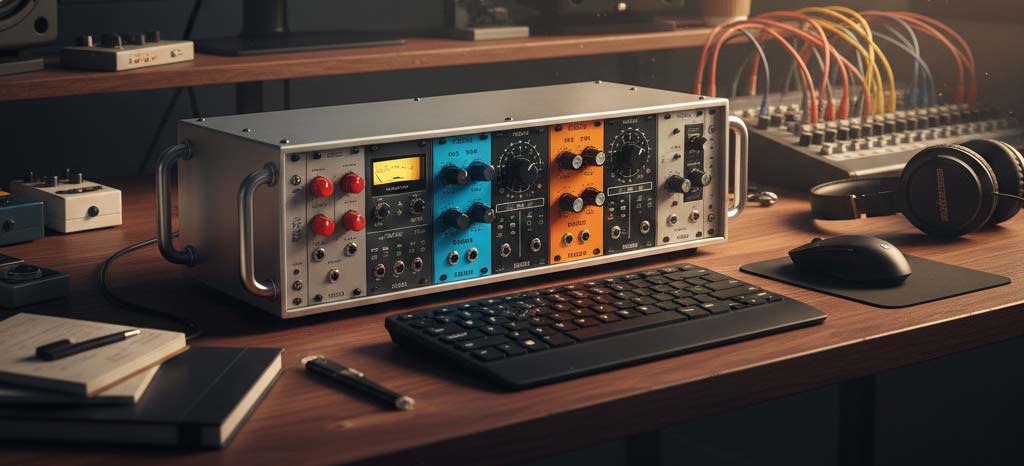 During this transition, we saw the rise of the 500 Series Lunchbox. Originally pioneered by API (Automated Processes, Inc.) in the late 70s, this format evolved into a universal standard by the mid-2000s. These portable chassis allowed engineers to break away from massive consoles and carry a curated selection of high-end analog preamps, EQs, and compressors in a small, mobile box. Engineers could now bring their favorite boutique hardware into any DAW setup, ensuring that even a mobile or home-based session had the authentic grit and soul of a world-class studio.
The Soul vs. The Circuit: The Great Hybrid Debate
This era also birthed the first major “sonic shock” of the digital age. In 1998, the world heard the Auto-Tune Effect for the first time on Cher’s hit song “Believe“. What was originally designed as a transparent tool for pitch correction was pushed to its digital limit, creating a robotic, “stepped” vocal sound that changed pop music forever. This original AutoTune effect is known as “The Cher Effect”.
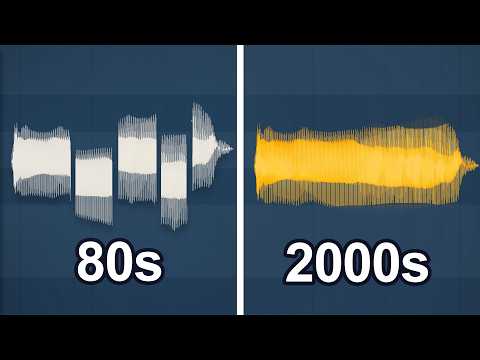
In 2005, T-Pain took this digital artifact and elevated it to an entirely new level. By leaning into the effect as a primary instrument, he turned the “Auto-Tune Effect” into a global staple. He even partnered with iZotope to release “The T-Pain Effect audio plugin” that democratized his signature sound for the masses; though now discontinued, it signaled a shift where artists became software innovators.
It eventually became an integrated part of the toolkit for countless singers and rappers, proving that digital manipulation could become as much of a signature “soul” as the analog gear that preceded it. These moments were our first real hint that digital tools wouldn’t just replicate analog—they would eventually create entirely new realities.
The Harmonic Debate: Pure Hardware vs. Digital Emulation
We saw countless shootout videos and magazine articles where the questions were fierce. Could digital ever truly capture the warmth of tape? Did moving “in the box” cause us to lose that organic, soulful feel? Some swore the hardware was irreplaceable, while others marveled at how close the emulations had become.
Past Analog vs Digital Shootouts By TravSonic
The Reality of Today: An Evolving Toolkit
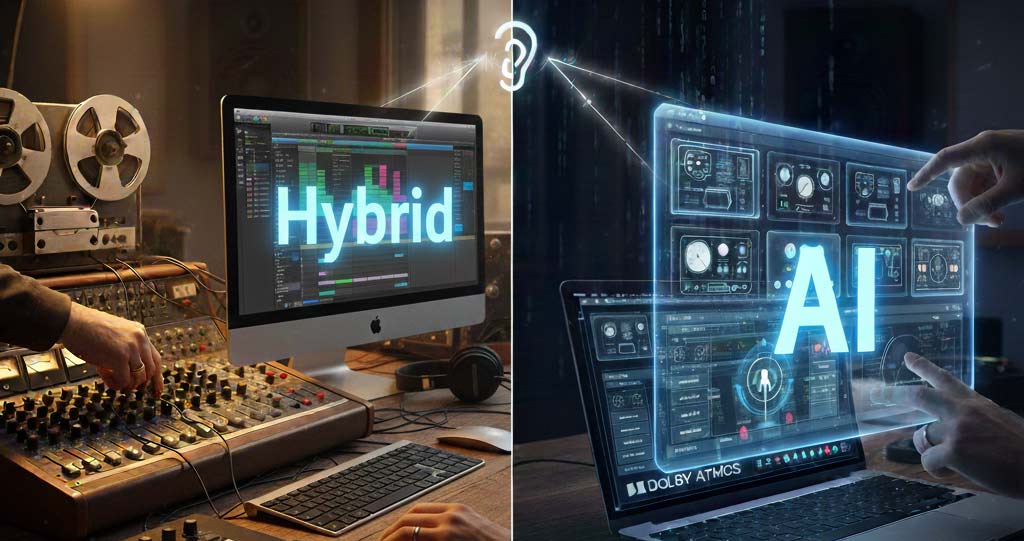 Fast forward to today, and that shift toward the hybrid audio mix is a reality. Mixing on a desktop or laptop isn’t just a possibility; it is an industry-accepted standard for ease and flexibility. Legacy analog gear, like the iconic Pultecs, 1176s, and Fairchilds, has been meticulously modeled into plugins. This allows engineers to carry the sonic history of the world’s greatest studios in a backpack.
In the world of motion pictures and theatrical sound, a hybrid audio mix created “in the box” via Avid Pro Tools is the universal norm, with Dolby Atmos serving as the industry standard for immersive storytelling. From local indie projects to multi-million dollar blockbusters, the digital platform is the foundation.
The New Hybrid Frontier: AI, the Human Ear, and the Future of Production
This brings us to the latest evolution in our field. The focus has moved from the hardware itself to the intelligence behind the knobs. The new hybrid frontier is AI vs. the Human Ear. Just as the late 90s saw a fierce backlash when digital workstations began to replace 2-inch tape, captured perfectly in the classic Tape Op debate, “Pro Tools: Work of the Devil?”, we are seeing that same skepticism return today.
We are witnessing a massive industry shift where AI-generated content is entering the mainstream. We see legendary figures like Timbaland partnering with platforms like Suno to launch AI-driven music projects, and viral “Heart on My Sleeve” tracks mimicking global stars like Drake and The Weeknd. At TravSonic, we’ve been tracking the rise of AI voice and its potential to shake the production industry as we know it.

AI: The Engine for Speed and Productivity
Using AI isn’t about abdicating the mix. It’s about efficiency.
-
Surgical Restoration:
Instantly learn noise profiles or align phase.
-
Consistency at Scale:
Use AI for EQ matching across dozens of inconsistent recordings.
-
Podcast & Audiobook Proofing:
Scan hours of raw narration in seconds to find mispronunciations or “fluffed” lines.
-
Intelligent Dialogue Leveling:
Balance conversation loudness while “smart” gating removes room tone without cutting off natural speech.
-
The “Foundation” Shortcut:
AI allows us to reach a solid starting point faster. It handles the fundamental plumbing so we can focus on the final 10% where the artistry lives.
The Frictionless Studio: AI and Cloud Collaboration
Beyond the knobs and faders, we are seeing a revolution in the environment where the hybrid audio mix happens. Digital workflows, AI, and cloud technology are working in tandem to remove the friction that used to slow down production.
In the traditional studio era, technical chores like balancing levels, tedious noise reduction, or hunting for resonant frequencies could eat up hours of a session. Today, AI handles this heavy lifting with intelligent algorithms, providing a first pass on EQ and compression. Cloud platforms then take it a step further by enabling seamless remote collaboration. Teams can now work on the same project files from across the globe in real-time, skipping the old cycle of upload, download, and repeat.
This shift does more than just speed up the clock; it democratizes professional results. By automating the tedious tasks and learning an engineer’s specific preferences over time, these tools allow us to spend more time on creative decisions and less on technical troubleshooting. At TravSonic, we believe this frictionless workflow is what allows us to keep the focus where it belongs: on the storytelling.
Looking Forward: A Shared Spotlight
While the future remains uncertain, the speed of advancement is undeniable. Just five years ago, AI voices were a novelty. Today, AI voices all over YouTube and TikTok, becoming global digital signatures for everything from faceless channels to high-energy ads. Familiar presets like the “Adam” and “Bella” voices have become so ubiquitous that they are essentially the new “industry standard” for social narration. In fact, we are already seeing AI-generated audiobooks entering the mainstream market through major platforms.
Is AI a fad? Probably not. The technology is evolving at breakneck speed, and it is something we simply cannot sidestep or bypass in our production workflows. In 2026, the industry has reached a new baseline: timelines are expected to be faster, and quality is expected to remain high, even on cheaper budgets.
At TravSonic, we see budget and intent playing a massive role in this crossover:
- The No-Brainer: For fast-turnaround creator videos and tight-budget social content, AI is an extremely affordable, high-speed solution.
- The Priority: For top brands and high-budget theatrical productions, full-scale human production remains the priority. In these high-stakes environments, AI is viewed as an enhancement, not a replacement.
While we’ve observed a rise in AI adoption, many of our clients still rely on human narration and on-camera actors to achieve an emotional depth that algorithms can’t yet replicate. This current era of the hybrid audio mix provides a choice between the surgical speed of AI or the nuanced soul of a human performer.
The choice we face isn’t between “Human” or “Machine,” but how we position the tech. We can see AI through the lens of fear—a threat of replacement—or we can see it as the ultimate studio assistant. It is a tool that handles the “plumbing” of a mix, allowing us to pilot the creative vision. At TravSonic, we believe the key to making AI work for us is to use it as an engine for productivity, ensuring that the human ear and heart still make the final, high-value decisions that define true artistry.
The Fallibility of the Algorithm
Even with all this progress, AI still lacks context. We see this in automated editing where tools mistakenly cut off essential filler sounds or dramatic pauses that are vital to the natural rhythm of speech. Because AI cannot yet emulate nuanced decision-making, the human ear remains the final compass.
- Intentional Imperfection: Humans recognize when a vocal crack is the heart of the song.
- Creative Risk: AI optimizes for what it expects, while humans optimize for the extraordinary.
Conclusion: The Artist Still Leads
The hybrid audio mix is a partnership. AI handles the technical chores so the engineer can focus on the art. Just as we successfully integrated digital plugins without losing our appreciation for analog character, we are navigating the AI era with one goal: keeping the human in the driver’s seat.
What’s your take?
Where do you stand in the new “AI Hybrid War”? Does AI feel like the Pro Tools revolution of the late 90s, or is this something entirely different?